VideoGen changelog
See the latest VideoGen features, workflow improvements, and product updates for creating videos with AI.
VideoGen 4.5 Updates: Animated Visuals, Automations, and More Control
Generate animated visuals in one run
Script and voiceover workflows now organize visuals into AI images, AI video, and Stock. Choose AI video to animate the generated images as part of the same run. The estimate includes the extra animation cost, and processing continues after you leave the project. Add reference media separately to guide the visuals.
Build automations inside VideoGen
Open Automations from the sidebar to browse Zapier workflows inside VideoGen. Connect a source app, create a video, and pass the finished export to the next app. You can also open the workflow in Zapier. Integration cards include video previews and clearer setup guidance.
Find the right workflow and example
Workflow cards and guides include short video previews showing how each workflow works. Learn from examples adds animated previews, more examples, and five categories: Ads, Social media, Storytelling, Explainers, and Presentations. Browse examples with the arrow controls, edit the prompt, and apply one to your current project.
More control over video restyling
Choose source footage from an upload, your video library, or a public link. Link imports show progress and errors beside the input. Portrait previews stay compact, leaving room for your prompt.
Restyling edits the source frame by frame and preserves its original aspect ratio, including custom formats. Trim the source, add reference images, and choose whether to keep its audio. Download links are refreshed when needed so older source files remain usable.
Switch workflows with the assistant
Ask the assistant to change an open workflow to another type. It carries compatible settings into the new workflow and asks for approval before replacing existing content, unless you enabled automatic approval. The approval explains that the switch clears the old content and cannot be undone.
Requests for a finished video can continue from drafting through generation in the same conversation, subject to your approval settings. Slack replies and developer API follow-ups retain the active conversation and project file.
Recover incomplete generations
When a storyboard finishes only some scenes, the preview shows how many succeeded and offers Retry failed scenes. Completed scenes remain available. Partial delivery refunds the workflow fee and failed-scene charges while retaining charges for successful scenes.
If a finished generation conflicts with edits made while it ran, Result needs review lets you compare and apply the retained video. You can recover the generated work without paying to generate it again. Applying the result can also continue its requested finishing and export steps.
Clearer progress and navigation
Generation banners, history, and preview availability track each output separately. Open the matching video from its task status card. Music generation keeps showing progress until it finishes, and queued tasks show progress before processing begins. Assistant activity timers exclude time spent waiting for your approval.
Playback that stays where you left it
Video players keep their selected playback mode while you watch. A background quality upgrade no longer replaces the player. Switching export tabs loads the selected export. Preview playback can also recover when you return after a long pause.
Exports offer an optional Enable higher quality playback setting for adaptive streaming. The downloaded video's quality stays the same. You can find exports in project file navigation and create embeds from the export controls.
Model 1 access, sharing, and developer API
Model 1 now supports direct generation and quota checks through the developer API, TypeScript and Python SDKs, and CLI. Approved team access and the separate Model 1 minute allowance still apply. These endpoints are separate from workflow APIs and are not exposed as Model 1 MCP tools or automation actions.
The application form asks whether future generated videos may appear in public marketing and examples. Either answer permits an application. Program credits include the same commercial video rights as Pro. The Model 1 page includes finished outputs, embed controls for published videos, a creator program, and research links.
Reference handling, scene continuity, dialogue language, speech through cuts, and background music have received further improvements. Completed videos remain available when their duration differs from the request, with a duration warning in API results.
Updated voice, music, and sound generation
Narration, music, and sound-effect generation use updated models. Voice speed, stability, and similarity controls remain available, while model selection is automatic. Saved projects using retired voices use replacement voices; existing generated audio stays unchanged.
Easier setup and file uploads
Account setup includes connecting VideoGen to an AI assistant and shows only the steps still needed. Integrations separates AI assistants from other tools. General attachment pickers accept supported documents, and both voiceover upload entry points accept audio or video. Unsupported-file messages explain which formats the input accepts.
Model 1 prepares large reference images automatically and keeps new references selected as uploads finish. ChatGPT uploads retain a device file picker and offer retries when a conversation attachment cannot be downloaded.
Other improvements and fixes
- Your selected image and video quality carries through generation, reference creation, and regeneration.
- Motion graphic previews load referenced media and fonts more reliably.
- Silent script and voiceover workflows preserve their planned timing without adding narration gaps.
- Starting a generation and then deleting its source workflow no longer interrupts the running job.
- Removing an open project file selects surviving work instead of leaving an unusable tab.
- Temporary session-refresh failures no longer sign you out immediately. Sign-in challenges can recover from network failures.
- Missing projects show a dedicated page instead of redirecting you with a background error toast.
- Historical assistant generation cards resolve the task status before reporting a failure.
- What's new opens the latest announcement instead of a sequence of older announcements.
- Python SDK polling handles response fields consistently. Developer API upload processing also recovers when the caller omits a file type.
- Payment authentication reminders no longer repeat for the same challenge, and automatic top-ups recheck the current balance before charging.
VideoGen 4.5: Restyle Your Videos
Change the look of existing footage
Video to video is available to all accounts, with generation subject to plan access and credits. Upload a clip or paste a video link, then describe the changes you want. Restyle a product demo, change a scene's look, or turn footage into animation while preserving its motion.
Guide the result with references
Add reference images of your product, character, or visual style. Use them to guide the edit alongside your prompt. The workflow preserves the source video's framing.
Choose the footage and audio to keep
Use Start and End to select the part you want to restyle, up to two minutes. Keep original audio is on by default. Turn it off to use generated audio instead. Captions, music, transitions, and your logo are available through the workflow's finishing settings.
Choose a quality level
Low, Standard, High, and Max let you balance generation quality and cost. High is the default. The estimated credit cost follows your selected quality and the length of footage you restyle.
Set up an edit with the assistant
Attach a video or paste its link in chat and describe the result. The assistant can create a Video to video tab, set the source and trim, add references, and adjust quality and audio settings. Continue editing beside the assistant before starting a generation.
Use video to video in your integrations
The developer API adds POST /v1/workflows/video-to-video for uploaded files and public video links. Remix actions and automatic export can return a finished download link. Video to video is also supported in the TypeScript and Python SDKs, CLI, MCP, and automation integrations.
Introducing VideoGen Model 1
Create a complete video from one prompt
VideoGen Model 1 creates videos up to ten minutes long, with sound. Describe a product ad, short film, animation, or explainer. Model 1 plans the story, dialogue, shots, and pacing, then generates and assembles the video. Shared references help keep characters, locations, and visual style consistent across scenes.
Guide the visuals with your own images
Add optional reference images of people, products, places, or styles. Model 1 uses them to guide the video without requiring a reference to be its opening frame. Watch example outputs with sound on the Model 1 page.
Request access for your team
Model 1 starts with a limited partner release. Open Model 1 in VideoGen to request access. Approved teams receive an hourly generation limit and a separate allowance of video minutes. You can request more minutes from the same page. Model 1 uses its own allowance rather than your regular VideoGen credits.
Apply for free AI credits
The Model 1 program offers a shared pool of $1 million in free AI credits for creators, filmmakers, and studios, including students and amateurs. Review the program and apply on the Model 1 page.
Content screening and AI identification
Model 1 screens inputs and generated video for prohibited content. Generated videos include an invisible watermark identifying them as AI-generated.
VideoGen 4.4: Brand References, Collaborative Editing, and Longer Clips
Add your brand, locations, and props
Save brands, locations, and props alongside your actors, products, and visual styles. Import a brand from its website or create one with a logo, colors, fonts, and writing style. Mention it with @ to give the assistant your brand voice and add its logo when the project has none. Reuse locations and props in storyboard scenes and prompt to video.
Edit while the assistant works
Keep working while the assistant generates or edits. Only a field receiving a live assistant draft stays read-only. Teammates and other tabs with edit access can save changes at the same time, and developer API runs no longer lock an open project.
Duplicate and organize project files
Duplicate or rename a workflow or editable video from its menu. Copies open inside the same project. The header menu links to Project home and Dashboard home, and the file browser sits beside the tabs. The Workflows collection keeps workflows available after they have produced a video.
Generate clips up to 30 seconds
All four video quality levels support clips up to 30 seconds in prompt to video, storyboard scenes, and the AI Playground. Storyboard scenes also accept longer spoken lines, up to the scene's supported duration. The developer API supports the same longer storyboard scenes.
Clearer speech and duration controls
Prompt to video reads the full prompt to decide whether a scene needs speech. You do not need to mark dialogue with quotation marks. When spoken lines exceed a fixed duration, choose Auto or shorten the text. Duration checks explain unsupported settings before generation starts.
More reliable editing and undo
Stock media appears in the timeline as soon as you select it. Typing in one field forms one undo step, while selecting an item leaves your edit history alone. Undo and redo retain loaded media details and preserve independent changes from collaborators.
Titles and settings keep what you type while saves complete. Generated images and video clips also fill their frame, including clips stretched to fit a longer slot.
Make, Premiere Pro, and ChatGPT
Find Make in Integrations with a setup guide. Premiere Pro has its own guide and Adobe Exchange link. ChatGPT setup opens the VideoGen plugin, where storyboards can use saved products, actors, and visual styles as references. The website also has an integrations directory with setup information.
Import listing photos from chat
Paste a listing link in the assistant to import up to 100 photos. Upload directly from the @ media menu in storyboard and prompt to video, then mention the new file. Finished video cards in chat show a thumbnail and duration and open the result.
Compare plans by video type
Pricing and upgrade screens estimate how many minutes of still-image, avatar, or generative video a plan's credits can make. A calculator helps compare plans for your mix of videos. Advanced is the recommended plan, and the billing controls show yearly savings.
Follow Add motion as it runs
Add motion shows progress in Tasks and on the preview banner. Images being animated show a loading overlay. Converting a batch of images to video displays the full estimated cost before it starts.
Other improvements and fixes
- Record in New project opens the recorder directly.
- Preview and Edit mode are remembered separately for each video.
- Finished videos no longer flash a new 0% generation overlay on refresh.
- Failed project creation no longer leaves an empty project behind.
- Failed generation tasks refund their credits more reliably.
- Credit errors show a recovery prompt, and storage upgrade prompts name the plan and storage limit.
- Background tabs continue checking task progress without reloading the project when you return.
- Narration containing pause tags generates correctly.
- Joining through a project share link no longer adds you to the team automatically.
- Authorized collaborators and link viewers can open private exports.
- Assistant replies stay below the message they answer and omit internal reference tokens.
- Developer API project lists include the team's projects. Brand, Location, and Prop references are available through the API, SDKs, CLI, and MCP.
VideoGen 4.3: Simpler Video Creation, Media References, and New Plans
Prompt to video on one screen
Write a prompt, choose the video quality and duration, then generate a clip from one screen. Add actors, products, or reference media with @ mentions. The same run creates the reference image and video, plus your selected music, captions, and logo. Prompt to video has no separate workflow fee; credits cover the media you generate. Free accounts can generate a reference-image preview; video generation requires a paid plan.
Use your media in visual prompts
Type @ to select a file from your media library. Use images as references in the assistant, image and video tools, storyboard visuals, slide images, and image editing. Each media chip lets you replace or edit its reference. Scripts and narration remain plain text.
Keep related work in one project
Workflows, editable videos, briefs, and exports each have a tab inside the same project. The tab row scrolls to keep every item within reach. Search, Add, Tasks, and Share stay beside the project name. Project home brings you back to the full collection, with list and grid views for recent files.
You can keep editing a workflow while a video generates. Start another run from the same workflow without replacing the earlier output. Finished work shows an unread dot without switching your active tab.
View and share exports inside your project
Export opens a finished video in its own project tab. Generate a thumbnail, share a view link, create an embed, download the file, or return to editing from that tab. Share project also lists your recent exports.
Turn a brief into several videos
Upload a brief, write one, or create it with AI. Generate deliverables plans the work and follows a checklist of videos. The assistant shows progress for each deliverable and opens its workflow when it is ready. Brief tables also support inserting and deleting rows and columns from a context menu.
Import products from a link
Paste a product-page link in the assistant, or choose Import product from URL on Project home. VideoGen imports the photos and creates a reusable product reference. Use a page for one product rather than a store home page or collection.
More control over products and avatars
Script, voiceover, and slideshow workflows include a Product selector beside Avatar. Selected products can appear in the generated visuals. Corner avatars have backdrop and size controls, with Apply to all for consistent settings across scenes. Selecting an avatar in the editor suggests its matching voice, and selecting a voice suggests its avatar.
Automatic clip duration
AI video tools can choose a clip length based on the action and spoken lines. Auto duration is available in the AI Playground, Animate, storyboard scenes, and prompt to video. For longer videos, the prompt-to-video duration menu points you to Storyboard to video.
Pro, Advanced, and Ultra plans
Compare the Pro, Advanced, and Ultra plans, including Max quality on Advanced and Ultra. Change your plan or billing frequency from Billing settings without leaving VideoGen. Credit prompts show available plan upgrades alongside top-ups, and eligible existing subscribers retain the better of their old and new allowances.
Start from an example
Browse examples by category, watch the result, and edit its starter prompt before creating your project. Examples cover ads, social videos, presentations, explainers, training, and film.
Automations return the finished video
Zapier, n8n, and Pipedream actions can wait for an export and return its project link, download URL, and thumbnail. Developer API workflows support automatic export and return a download link when the export is ready. Webhooks report export results and uploaded-file readiness.
See where your credits go
The Usage page groups related charges under the operation that used them. Expand an operation to inspect its individual charges. Included and additional credit balances remain visible, and plan upgrades refill included credits more reliably.
Other improvements and fixes
- Slides to video starts with captions off and marks slides whose images need updating.
- Applying a preset keeps your script, scenes, slides, and uploads.
- Video templates open in the editor. Start from upload also opens on the timeline and sizes the first section to your media.
- Failed editor generations remain in history with their failure reason.
- Assistant replies include Copy and feedback controls. The desktop assistant sidebar can be resized.
- Failed or timed-out assistant messages offer Retry and retain their status after refresh.
- File analysis no longer uses generation credits.
- Stock avatars retain transparent backgrounds in exports.
- Teammates see live generation progress on shared projects.
- Monthly included credits refill more reliably, including when payment events arrive out of order.
- Public export pages show the creator's display name instead of their email.
- Changing your password signs out your other sessions.
- Pronunciation replacements work with Arabic and similar scripts.
- Web images has been removed from the media tools. Existing affected images use replacement stock photos.
VideoGen 4.2: Actors, Slideshow Themes, and a More Capable Assistant
Create actors without leaving your workflow
Actors are first-class now. Upload references or start from a prompt, then generate name, description, and shots in a two-step flow. The avatar picker on script, voiceover, and slideshow includes Create actor, so you can add a custom presenter and keep working. Chat remembers the actors and files you already mentioned, so follow-ups like "use that actor again" stay on the right person.
A built-in catalog of actors, products, styles, and themes
Entities has a Built In tab for VideoGen's included catalog: actors, products, visual styles, and slideshow themes you can drop into a new video. Home shelves put Actors and Products next to featured workflows, with a Create option when your library is empty. Built-in cards are read-only. Use + to start a project with that look or character.
Storyboard with multiple actors and lip-sync
Storyboard to video is the default path for most new videos. Attach actors above the Visual field, write who is on camera, and tag who speaks in Script. Talking scenes lip-sync the speaking actor and use that actor's voice. Off-screen ads get a Narrator chip for a short voice description instead of a fake on-camera person. No avatar is the first option in the avatar list when you want visuals only.
Slideshow themes that restyle the whole deck
Slides to video has a Theme picker on the canvas toolbar. Choose a built-in look or create your own slideshow theme, then generate slides that share one design system. Changing theme on a deck that already has images asks whether to regenerate them. Uploaded PDF and PowerPoint pages can stay as they are; VideoGen still learns a theme in the background so later edits match the original deck. Presets now save the theme with your other slide settings.
An assistant that pauses for approval
The project assistant is server-led. Two tabs on the same project no longer fight over edits. The script writer goes read-only while the agent is working. When a change needs a decision, the run waits for you to approve it, then continues. If the assistant cannot finish a control itself, it highlights the real button and tells you what to click. AI assistant chat is about half the previous token price.
Add motion from preview
Still-image drafts can pick up motion without opening Remix first. The preview banner is Add motion: Zoom (Ken Burns, free), Transitions (free), or AI video (Pro). Zoom applies to every eligible still, including uploads. AI video starts from a budgeted pattern so a large still deck does not default to animating every frame at once. Slideshow remix can also stagger layer animations so text and visuals do not all hit at the same time.
Creative services, from a brief
Done for you is now Creative services. Describe the project, attach references if you have them, and submit a brief at no charge. A producer emails a proposal and delivery date. Home has a promo shelf and a Learn from examples row: open how a sample was made, then start with that prompt.
Embed finished videos
The public view page has Get embed code. It gives a public video URL plus install and code snippets for the VideoGen player packages so you can drop the video into a site. The control stays disabled until the export is ready.
Project steps that ask before they move
Every Project steps row that leaves the current step opens a custom confirmation. Workflow warns that generated sections will be cleared. From the editor, Preview is locked: you cannot return to the watch screen once you have started editing. Cancel always returns to Project steps.
Motion graphics you can preview live
Motion graphics show a live sandbox as soon as the code is ready. Export is a separate step when you want a file. You can allow or block sub-tools (images, clips, voiceover, stock) and keep a transparent overlay by default.
Other improvements and fixes
- Replacing an asset no longer stretches or compresses the rest of the timeline (except TTS-to-TTS when Scale concurrent scenes is on).
- Exports with both a watermark and an end screen no longer freeze on the branded close.
- View-only collaborators cannot generate, restart, or edit from workflow and preview headers.
- The generate-video chat card shows the real failure (credits, policy, too-long script) instead of a generic could-not-generate message.
- Seeking on preview updates the playhead.
- Default storyboard music is quieter.
- Collaboration presence shows on workflow, preview, and new-project steps, not only the editor.
VideoGen 4.1: Generative Storyboard, Editor Power Tools, CLI, MCP, and SDKs
Fully generative storyboard to video
Storyboard to video is no longer a thin wrapper around stills. Generate scenes end to end, keep characters consistent with entity-aware references, and move from outline to playable video with fewer manual patch-ups. The storyboard flow itself got a dedicated UX pass so planning and generation feel like one product.
Script to video, sharpened again
The script to video workflow got another UX pass focused on clarity and momentum: cleaner writer layout, better floating controls, and less friction between drafting, styling, and generate. Small copy and navigation fixes make restart and remix paths obvious when you want a second take.
Editor power tools
The editor is much more agent-friendly. Floating prompts support reference-image attachments for edit and animate. Generation history sits on the canvas as a first-class action. Direct side-panel asset editing routes into the same floating prompt UX. Project-level audio gets its own layer, timeline insertion between clips is clearer, and multi-select drag is less surprising.
Transitions with sound, and more control
Section transition duration is editable from the side panel. Generative sound effects can ride along with transitions, so cuts feel produced instead of silent. Timeline performance was refactored so dense projects stay responsive while you scrub and rearrange.
Royalty-free sound effect library
Browse and add royalty-free sound effects without leaving VideoGen. Pair them with transitions, accents, or timeline moments the same way you already place music and voiceover.
Generative slides and motion graphics
Slideshow workflows can generate slides without forcing a PDF upload first. Motion graphic assets can carry arbitrary Remotion code for richer animated compositions. Lottie support lands for motion-friendly assets in the editor stack.
End screens on exports and clips
Exports and AI video clip generation can include an end-screen mode, so finished videos can close with a polished final beat instead of cutting to black.
Avatars that stay on screen
Avatars now stay visible for the full video duration when they should, and avatar quality lives in the picker where you expect it. Entity-aware avatar tooling makes character setup more consistent across workflows.
Voiceover and transcript improvements
Voiceover flows support transcript upload and scene-aware handling, with temporary-output cleanup so intermediate media does not clutter your library. Audio trim timings are honored on export, and waveform rendering respects gaps and playback speed.
What's new in the product
A What's new experience surfaces recent product updates inside the app, so you do not have to hunt the website changelog to learn what changed.
Developer surface: custom SDKs, CLI, and MCP
Hand-written TypeScript and Python SDKs replace the older generated clients, with clearer resource namespaces and wait helpers. The VideoGen CLI mirrors the same operations from the terminal. MCP connects Cursor, Claude Desktop, and other agents to the live VideoGen API tools. Production API add-on customers get a larger included credit grant for shipping at scale.
Other improvements and fixes
- Preview playhead resets correctly when you enter a freshly generated preview.
- CJK TTS alignment fixes for languages that previously drifted.
- Invite-collaborators banner on export view pages.
- Tasks UI available on more workflow steps that can start work.
- Lead qualification CTAs route through Cal.com instead of in-app budget modals.
- Free API exports can carry a watermark where required.
- Stability fixes across MCP auth, SDK packaging, storyboard scene migrators, and end-screen edge cases.
- Performance and React Compiler cleanup across the frontend.
VideoGen 4.0: New Home, Stronger Workflows, and a Rebuilt Editor Foundation
A redesigned home for starting work
The dashboard is rebuilt around how people actually start videos. Browse workflow shelves, jump into AI media tools from the home grid, and get back to recent projects faster. Loading states, empty states, and navigation are tighter so the home screen feels like a launchpad instead of a waiting room.
Script, voiceover, and generative workflows
Script to video and voiceover to video got a full UX pass: clearer style steps, better defaults for post-production, logo controls on workflows, and a smoother path from prompt to finished preview. Prompt-and-media generation is now a first-class workflow, so you can start from a prompt plus reference media without bolting steps together by hand.
Storyboard to video
Storyboard to video is available as a full workflow. Plan scenes, generate visuals with character consistency in mind, and move into the editor when you are ready. Character grids and sequential generation help recurring people stay looking like themselves across scenes.
Layer arrangements and transitions
The timeline foundation is new. Sections use explicit layer types for audio, background visuals, and visual overlays, so arrangements stay predictable as projects get complex. You can add asset-to-asset transitions, audio transitions, and finer post-production transition controls without fighting the old single-arrangement model.
Preview that feels like a product moment
After generation, you land in a dedicated preview experience with cleaner playback controls, clearer edit/remix/restart actions, and a feedback assistant for iterating on the result. Preview analytics and mobile preview flows were rebuilt so the first watch is easier on every device.
Quality tiers, including Max
AI quality is unified across image, video, and avatar generation. Pick the tier that fits the job, save your preference across workflows, and use Max when you want the strongest agent and generation quality. Try Max prompts make the top tier easier to discover without burying default settings.
AI playground and media tools
Create a project directly from an AI playground result. Generative tools handle slides and PDFs as image inputs more reliably, and you can generate AI thumbnails on the public view page. Replace actions show up on generatable assets so iteration stays one click away.
Credits and usage clarity
The credit system is easier to understand day to day. The dashboard shows daily usage broken down by feature, team credit charts are available in the ledger, and you can export usage to CSV. Included-credit refills, top-up purchase tracking, and clearer included-vs-additional credit copy reduce surprise when you scale up.
Presets and templates
Presets are workflow-aware: save caption style, logo position, and the settings that actually matter for the flow you use. Public video templates and remix-template entry points make it easier to start from a finished look instead of a blank timeline.
Developer API and CLI
The developer API matured into a stable workflows-and-tools surface with better examples, guides, and rate limiting. Install the VideoGen CLI to drive the same API from your terminal and CI. Webhooks, quality parameters on workflows, and broader remix-action coverage make automation paths production-ready.
Other improvements and fixes
- Faster editor performance for large projects, including virtualized task lists and fewer forced layout thrash paths.
- More reliable captions, TTS alignment, and b-roll cut timing.
- Avatar selection and extract-slides avatar flows fixed for edge cases that previously failed generation.
- Create-project-from-playground and team-switch project reload bugs fixed.
- Drag-and-drop, upload, and export stability improvements across the editor.
- Mobile banners, preset cards, and preview chrome redesigned to take less space.
- Sign-in and sign-up moved to lighter popovers.
- Getty entry points removed from the product UI.
- General reliability work across assistant progress, credit top-ups, and project sharing permissions.
VideoGen 3.4: Every AI Feature, Now Included — AI Video, AI Avatars, and More

Every AI feature, now included
Generative video, AI avatars, AI images, and every other AI feature are now available on every paid plan. If you're on Pro, you get access to everything. If you're on Business, you get all of that plus the Premium stock library included at no extra cost, along with a higher monthly credit allotment.
A better script-to-video experience
We've overhauled the script-to-video workflow with improved AI image generation, more visual style presets, smoother section transitions, built-in effects, and better defaults across the board. The result is higher-quality videos straight from a prompt, with less manual editing needed afterward.
Quality tiers for AI images
You can now choose between faster, lower-cost drafts and higher-quality finals when generating AI images. Pick the tier that fits the job — quick iterations or polished results. We'll be expanding quality tiers to more features over time.
Predictable usage with credits
Your plan now comes with a monthly credit allotment that refills at the start of each billing cycle. A rate card shows what each action costs, a usage ledger lets you see where your credits went, and you can buy additional credits or enable automatic top-ups at any time from the Usage tab.
The VideoGen API
You can now create videos, images, voices, and avatars programmatically — or run full workflows like script-to-video from your own apps. Get an API key from the Developers tab, install the TypeScript or Python SDK, and generate your first video in minutes.
Your AI agent now thinks out loud
When you generate a video, the AI agent shows its reasoning as it works. You can follow along as it makes decisions about visuals, pacing, and structure — so you always know what's happening and why.
Project-wide themes
Set colors, fonts, and logo for the entire project from a dedicated Theme tab. Every section picks up the theme automatically, keeping your videos visually consistent without editing each one individually.
More control in the editor
Lock assets in place while keeping their content editable. Drag assets between layers. Crop images inline without leaving the canvas. Edit SVG colors directly. Add borders to images and shapes. Duplicate assets with one click, and hold Alt while dragging to disable snapping.
Better sharing
A redesigned share popover lets you set viewer, editor, or admin access for each collaborator. Your team's email domain is auto-detected so adding colleagues is faster. Projects from other teams now open in read-only mode to prevent accidental edits.
Other improvements and fixes
- Faster, more reliable uploads with visible progress indicators.
- Fixed 4K export issues for high-resolution renditions.
- Hover to preview stock videos before inserting them.
- Faster video encoding for exports.
- Security hardening across the product.
- General stability and performance improvements.
VideoGen 3.3: Collaborative Editing, Visual Styles, and Script Regeneration
Real-time collaborative editing
Projects are now fully collaborative. Invite teammates to edit the same project simultaneously - changes sync in real-time across all editors. You can see who's currently working on a project and where they're editing, so you never overwrite each other's work.
Visual styles for script to video
When creating a video from a script, you can now choose a visual style to guide how images and media are generated. Select from styles like anime, cinematic, minimalist, or corporate to give your video a consistent look without manually editing each asset.
Redesigned script to video workflow
We've rebuilt the script to video workflow to give you more control. You can now regenerate your script at any point - tweak the tone, adjust the length, or take it in a new direction without starting over. The new flow makes it easier to iterate until your script is exactly right.
Other improvements and fixes
- Upgraded our media engine for faster, more reliable uploads, previews, and exports.
- Improved transcription speed and reliability.
- Fixed an issue that could cause upload failures with large files in certain cases.
- Fixed an issue with drag and drop from your file system.
- Resolved rare export issues affecting audio tracks.
- General stability improvements across the editor.
Export Fixes & UI Improvements
Fixes & stability
- Resolved export failures caused by unexpected video encodings on avatar and Getty asset files.
- Fixed an issue where the usage limit notification would occasionally fail to appear when credits were exhausted during generation.
- Refined the upgrade modal layout for improved display on smaller screens.
Image-to-Video Generation & Performance Improvements
Image-to-Video
We’ve added an "Image to video" option to the "Generate AI clip" workflow: start with an image and a prompt, and VideoGen picks the best model to animate it. You can choose to include audio in the generated video clip as well.
If you have an existing image that you would like to animate, you can select the image and use the "Animate to video" action in the right side panel.
Fixes & stability
- Resolved an issue where dragging an asset upward would incorrectly add extra layers to all sections.
- Fixed a bug that occasionally caused text-to-speech generations to be truncated prematurely.
- Improved mobile playback performance with better memory efficiency and support for multiple concurrent audio and video tracks.
Subscription & Voice Improvements
Better subscription upgrade flow
- Existing subscribers upgrading their plan are now redirected to a Stripe-hosted confirmation page for a smoother checkout experience.
Fixes & stability
- Resolved an issue where upgrades on subscriptions with an invalid payment method would fail silently.
- Fixed a bug that caused in-world text-to-speech to fail when scripts contained multiple consecutive line breaks.
- Corrected character timing alignment for text-to-speech generations using pronunciation replacements.
- Fixed an issue preventing Stripe customer data from being properly linked to some user accounts.
VideoGen 3.2.0: Faster Editing, New Annotation Tools, and More Reliable Voiceovers
New features
Workflows
Each new video now starts with a workflow. We are launching with 7 core workflows, with plans to add more in the future.
- Idea to video (recommended for beginners): Create a full video from an idea, notes, or uploaded files.
- Script to video: Turn a finished script into a narrated video with visuals.
- Voiceover to video: Upload a voiceover. AI will add b-roll and captions.
- Record: Record yourself, your screen, or both. Then, edit with AI tools built in, like auto captioning and translation
- Upload and edit: Upload media and directly edit, caption, or translate.
- Generate AI clip: Generate a 5-10s AI video clip from a prompt. Then, edit freely.
- Video editor: Edit from scratch with built-in media libraries and powerful AI tools.
Additionally, users can request a new workflow!
Text and animation improvements
- Inline text editing is now supported, making it faster to refine on-screen copy without breaking your workflow. Create bold/italics, add auto-formatted bullet lists, or add animations.
- Animations now have a duration slider and are more performant.
- Text animations have 4 modes: All line-by-line, word-by-word, or character-by-character.
Performance improvements
- Rebuilt the editor from the ground up to dramatically reduce lag and improve overall responsiveness.
- Optimized long timelines so creating and editing longer videos stays smooth from start to finish.
- Added full support for mobile playback in video previews.
New tools
- Added line and arrow annotation tools for quick callouts, highlights, and on-screen guidance.
- Added duplicate section option.
- Added box select option for multi-selecting layers in the timeline.
- Redesigned core flows to reduce clutter, surface the most important actions, and make navigation more intuitive.
Other improvements and fixes
- Changed primary button color from red to blue.
- Improved layouts in the script / wireframe storyboard view with automatic animations, better pacing, and more.
- Fixed an issue that could prevent avatars from being regenerated in certain cases.
- Added media style presets to the idea to video and script to video worfklows (Free stock, AI image, and Premium iStock).
- Added a more accessible multi-step product tour.
- Improved the post-upgrade onboarding flow to help you get back to creating faster.
- Improved voiceover reliability and resolved multiple edge-case failures.
- Optimized script writer to align better with user prompts.
- Improved project sharing reliability.
- Improved Import from URL to automatically add files to project.
- Additional bug fixes and UX polish across the editor.
New Voice Features
More Text-to-Speech voices
- We’ve added new voices to our TTS voice library.
Adjustable voice speed
- You can now edit Text-to-Speech speed to better match your video’s pacing.
Fixes & stability
- Resolved an issue that could cause video generations in Korean to fail.
- General bug fixes and performance improvements.
VideoGen 3.1.0: New features and improvements
New Features
Recording studio
- Record your webcam and screen directly inside the editor.
- Instantly upload recordings to your project timeline for seamless editing.
- Supports microphone input and multi-source capture for creators and teams.
New ways to edit sections
- Section Transitions: Smooth, customizable transitions between scenes.
- Section Backgrounds: Add solid colors, gradients, or media backgrounds to sections.
- Slides Tab: Quickly preview and manage all your sections like a deck of slides.
- Bulk Animations: Apply animations or effects to multiple assets in one action.
New asset actions
- Multi-select Property Control: Adjust position, timing, and animation for several assets simultaneously.
- Send to Front/Back: Reorder assets visually in your timeline with new context menu actions.
Content sources & redesigned outline
- Streamlined outline view for faster navigation and editing.
- Improved organization for text, media, and sections for a cleaner workflow.
Other improvements and fixes
- Fixed text-to-speech timing and pronunciation issues.
- Fixed flickering and flashing issues during export rendering.
- Improved voice-over regeneration and avatar playback reliability.
- Fixed delayed media loading and improved overall export stability.
- Smoothed out mobile preview playback and improved device handling.
- AI agent now consistently follows preset custom instructions and writing style.
Performance improvements
We've made significant performance improvements across the platform to deliver a faster and smoother editing experience:
- Timeline performance: Optimized timeline rendering and interactions for noticeably smoother playback and editing, even with complex multi-layer projects.
- Faster project loading: Reduced project load times, getting you into the editor faster.
Mobile preview improvements
The mobile preview now loads faster and runs more smoothly across all devices:
- Thumbnail assets for faster loading: The mobile preview now uses optimized thumbnail assets instead of full-resolution media, resulting in faster and more efficient loading times.
- Fixed editor crashes: Resolved issues that were causing the editor to crash on mobile devices.
- Improved audio playback: Enhanced audio playback reliability and synchronization in the mobile preview.
Improved export reliability
We've enhanced the export pipeline to make video exports more reliable and consistent. Exports now complete more successfully, with better error handling and recovery for edge cases.
Fixes regarding AI avatars
We've fixed a bug in our AI avatar generation that was blocking some users from seeing their avatar in the editor. We also made it easier to decide whether or not an avatar should be generated for a video by adding a "Narration mode" option in the "Overview" page.
Other improvements and fixes
- Added more fonts to the text editor, giving you greater flexibility in styling your video content.
- Renamed "Auto select" to "Auto replace" for clearer indication of the feature's behavior.
- Added context menus to frames, providing quick access to common frame actions.
- Added canvas display to frames for better visual preview of frame content.
- Added "Add voiceover" button to each section in the script that doesn't have a voiceover, making it easier to add narration where needed.
- Changed the design of sections in the timeline, moving the header to the top.
- Fixed bugs with the timeline including asset and section trimming issues.
- Fixed issues with timeline zooming that were affecting precise editing.
VideoGen 3.0: Agentic Video Editor
VideoGen 3.0 transforms our platform into a full-featured video editor powered by AI. This release introduces a redesigned three-stage creation flow (Overview, Outline, Editor), a brand-new interactive canvas, and an enhanced timeline editor. We've rebuilt our rendering pipeline for perfect preview-to-export accuracy, added a background task queue for reliable long-running operations, and expanded our stock library with over 12 million new assets. Together, these updates create a more visual, intuitive, and powerful editing experience.
New video creation flow: Overview → Outline → Editor
We introduced a redesigned video creation flow built around three stages — Overview, Outline, and Editor — to make project setup and AI collaboration more structured and predictable.
Overview page
In the Overview page, you can upload images, videos, and audio files that you want the AI agent to use when generating your video. These assets serve as context for the AI — they can appear directly as visuals, help guide topic understanding, or be referenced when building the script and outline.
You can also specify your media sources, such as Free Stock, Wikimedia, iStock, AI Images, or Music. The AI agent will draw from these sources during generation, combining your uploaded assets with external visuals and audio to produce the most relevant media for each scene.
You also have more fine-grained controls, allowing you to define your aspect ratio, duration range, and language.
Outline page
After submitting your brief, the AI agent creates a structured outline that breaks your video into sections.
Each section is assigned a section type based on its audio handling:
- AI Voiceover: Generates an AI voiceover that narrates the section text.
- Transcribed Audio: Plays the original uploaded audio or video file, transcribed for editing.
- No Voiceover: Plays media as-is, without narration — often used for standalone clips or cinematic sequences.
You can review and edit these sections before moving into the editor.
Featured media
Within each section, you can set featured media, which takes priority over AI-selected b-roll. Featured media ensures specific visuals (like brand clips, demo videos, or uploaded footage) always appear in the final render for that section.
This new three-stage workflow creates a clearer separation between planning, structure, and editing — while giving the AI a stronger context for generating accurate visuals and narration.
New layout system
We introduced a new layout system that gives users more control over how text and visuals are arranged within each section.
Layouts determine the visual structure of a scene — how the title, subtitle, and media appear on screen — making it easier to match the presentation style to the content type.
The following layouts are now available in the editor:
- Auto: Lets the AI automatically select the most suitable layout based on your content and media.
- Full-Screen Media: Displays the visual asset at full frame.
- Simple Title: A clean layout with a title and subtitle on a neutral background.
- Hero Title: Places text over background media for impactful opening or transition moments.
- Split (Text Left / Text Right): Divides the screen between visuals and text, ideal for explainers and side-by-side comparisons.
- Lower Thirds: Overlays text at the bottom of the frame.
- Simple Text: Focuses on text-based content with a neutral background.
Interactive canvas with transform and drag controls
We've added a brand-new interactive canvas that allows direct manipulation of elements in your video:
- Drag: Click and drag to reposition elements precisely where you want them.
- Resize / Transform: Adjust size and scale interactively using handles.
- Snapping: Elements snap to guides and other objects for clean, aligned layouts.
- Animations: Add enter and exit animations to any element directly from the canvas.
These controls are powered by our unified rendering engine, meaning you can see exact, real-time changes to your final composition as you work.
This brings a much more visual and intuitive editing experience — you can now fine-tune positioning, scaling, and animations directly on the canvas without manually entering numbers.
Enhanced timeline editor
We've redesigned the timeline editor to give you more precise control over your video's timing and structure:
- Layer Management: Work with multiple layers of media, text assets, and shapes, all organized in a clear timeline view.
- Split: Divide clips at any point to create separate segments you can edit independently.
- Trim: Adjust the start and end points of any clip to control exactly what appears in your video.
- Reorder: Drag clips to rearrange them and change the sequence of your video.
The timeline syncs in real-time with the canvas preview, so every change you make is immediately reflected in your composition. You can scrub through the timeline to preview specific moments, making it easy to fine-tune transitions and timing across your entire video.
Re-implemented preview and export pipeline
We've overhauled our video rendering pipeline so that both preview and final export now run through the same underlying renderer. Previously, previews and exports used slightly different rendering code paths, which could occasionally lead to inconsistencies between what you saw while editing and the final output.
By consolidating them into a unified pipeline:
What you see is what you get – the export will now perfectly match your preview.
Rendering bugs are easier to track and fix because there’s only one rendering path to maintain.
We can introduce advanced editing features more quickly, since any improvements to the renderer apply to both preview and export automatically.
This foundation makes video editing more reliable today and faster to evolve in the future.
Background task queue
We implemented a new background task queue to make long tasks run more reliably, even if you close the tab before the process completes. The following actions will always be executed as background tasks:
- Generate outline
- Generate video
- Generate image
- Generate video clip
- Generate text-to-speech
- Generate sound effect
- Scan website
With minimal latency, automatic retries, and multiple fallbacks, this new system was built from the ground up to make the video generation experience as seamless as possible for our users.
Expanded stock library with >12M new assets
We’ve expanded the built-in stock media library with over 12 million new assets, including integrations with Pexels Images and Wikimedia Commons. This update provides broader visual coverage across topics, giving the AI agent access to both high-quality stock footage and educational media such as diagrams and public figures.
Other improvements and fixes
- Our AI agent will now automatically select an AI voice and avatar (if needed) based on the contents of your script and locale.
- We introduced a new "Deep Research" mode that allows the AI agent to perform multi-step reasoning to build outlines with greater depth.
- Added "Generate sound effect" media tool, which converts any prompt into a short sound effect audio asset.
- Content filter setting now applies to the stock library search filter, preventing unwanted inclusion of inappropriate assets.
- Included option on the "Team" page for a member to leave their team. Previously, members could only be removed by one of their admins.
- Fixed issue causing website scans to fail on any website without a meta description tag.
- Improved reliability of web scraping system to download images from the requested site.
- Enforced strict ordering of subscription updates in our backend to prevent occasional subscription data syncing issues.
- Website scans now always include the website's Open Graph image as the first entry in the list of scraped images.
- Users can now click a button in "Billing settings" to manually resync their subscription data.
- Increased rate limit on video exports for paid subscribers.
- Resolved issue causing storage limit errors to not be properly displayed to the user.
Better handling of inactive subscriptions
We overhauled our UX for dealing with failed subscription payments across the entire app. Now, when you attempt to use any paid feature while your subscription is inactive, a modal appears with clear instructions on how to reactivate your subscription. From here, you can view the incomplete invoice, manage your subscription, or contact our customer support team (with the relevant details of your account automatically included in the conversation). There is also a clear warning that your subscription is inactive on the main dashboard with a button to open this modal.
Other improvements and fixes
- Resolved compatibility issue causing some old projects to fail to generate.
- Added "Upload" and "Change" buttons to the right side panel for asset groups
- As a temporary fix to prevent accidental regenerations of title screens into stock footage, the "R" keyboard shortcut is disabled on the top layer.
- Polished UI and included examples of high-quality results for generative AI tools.
Project sharing
You can now share a copy of your project with your teammates. Click "Share" in top-right corner of the project editor, click "Share a copy", and then enter a comma-separated list of emails you'd like to share the project with. Each recipient will receive a full copy of your project in their inbox, allowing them to edit, generate, and export the video from their own account. Recipients who are not already part of your team will be added to your team upon acceptance of the invitation.
"Generate video clip" tool
We introduced a new "Generate video clip" tool that fully synthesizes a 5-10 second video based on a prompt. It may take a few minutes to generate, and results are best for well-structured prompts with specific subjects, actions, and settings. We are currently offering this tool exclusively to Business subscribers.
Other improvements and fixes
- Changed teams billing behavior to immediately charge prorated amount after adding a new member.
- Expanded our voice library with a larger variety of regional accents and dialects.
- Added "Create public view link" popover, allowing users to export and make the view link public in a single click.
- If a view link is made public while the export is pending, the Open Graph preview image is now updated to match the exported video upon completion of the export.
- Finalized migration of personal workspaces to teams, resolving several miscellaneous compatibility issues.
- Improved loading speed on the landing page with progressive loading of assets.
- Enabled content filter by default for all new users to prevent inappropriate image generations.
- Removed "AI" watermark on avatar video generations.
- Included an avatar button next to the voice button in the script editor, increasing visibility of our avatar generation feature.
- Clicking outside of a modal no longer causes popovers underneath the modal to close as well.
Personal workspaces are now teams
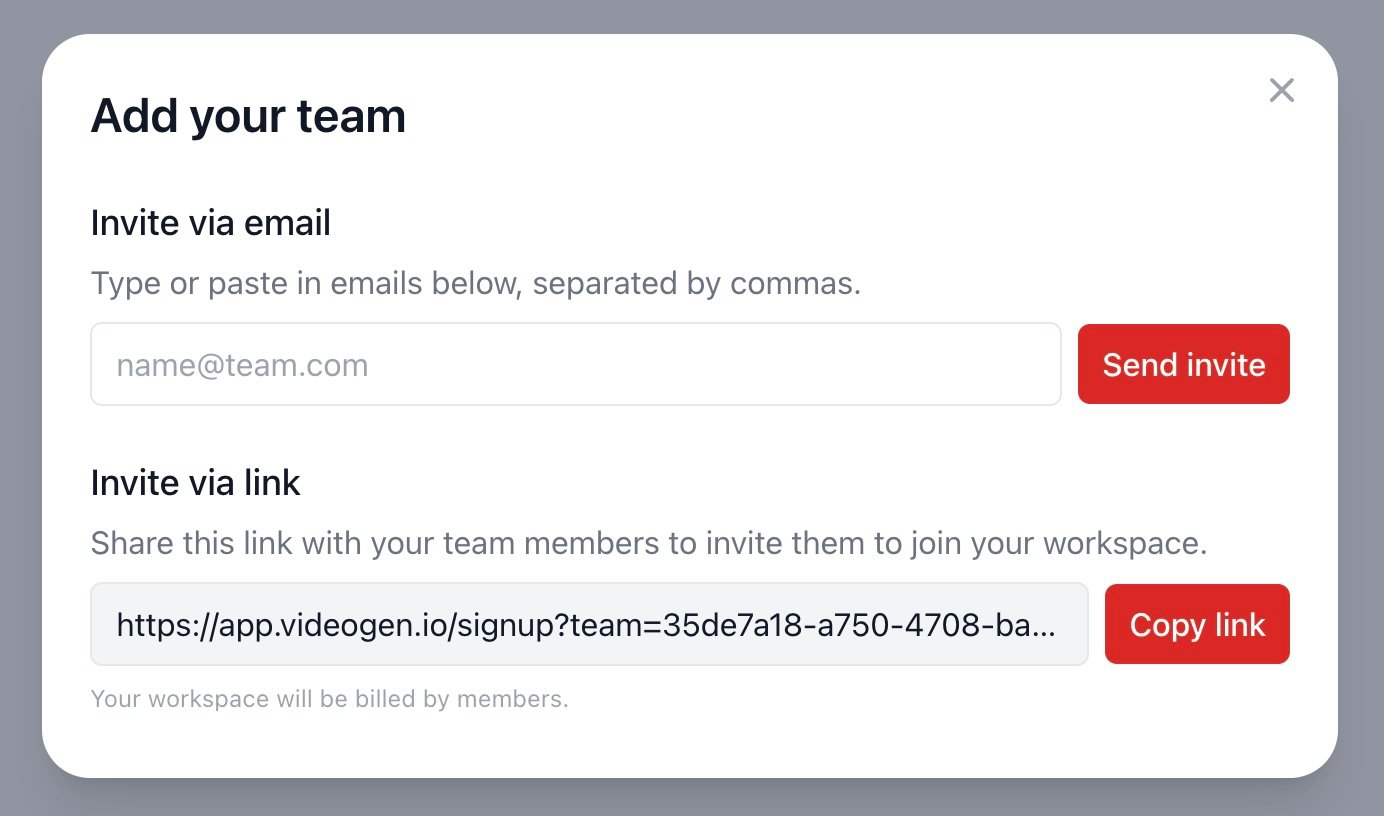
We converted all personal workspaces to single-member teams, making it easier than ever to create videos alongside your teammates. To invite your teammates, simply click "Invite teammates" on the top-right corner of the dashboard and enter their emails. To see a list of all of your team members and modify their permissions, visit the Teams page.
Other improvements and fixes
- Enhanced the music library with significantly more tracks across various genres.
- Added more checks to ensure that teammate additions and removals are always reflected instantly in the subscription quantity.
- Resolved issue causing infinite buffering on the video export view page.
- Fixed several small subscription processing bugs that were causing delays in subscription metadata updates.
Media tools
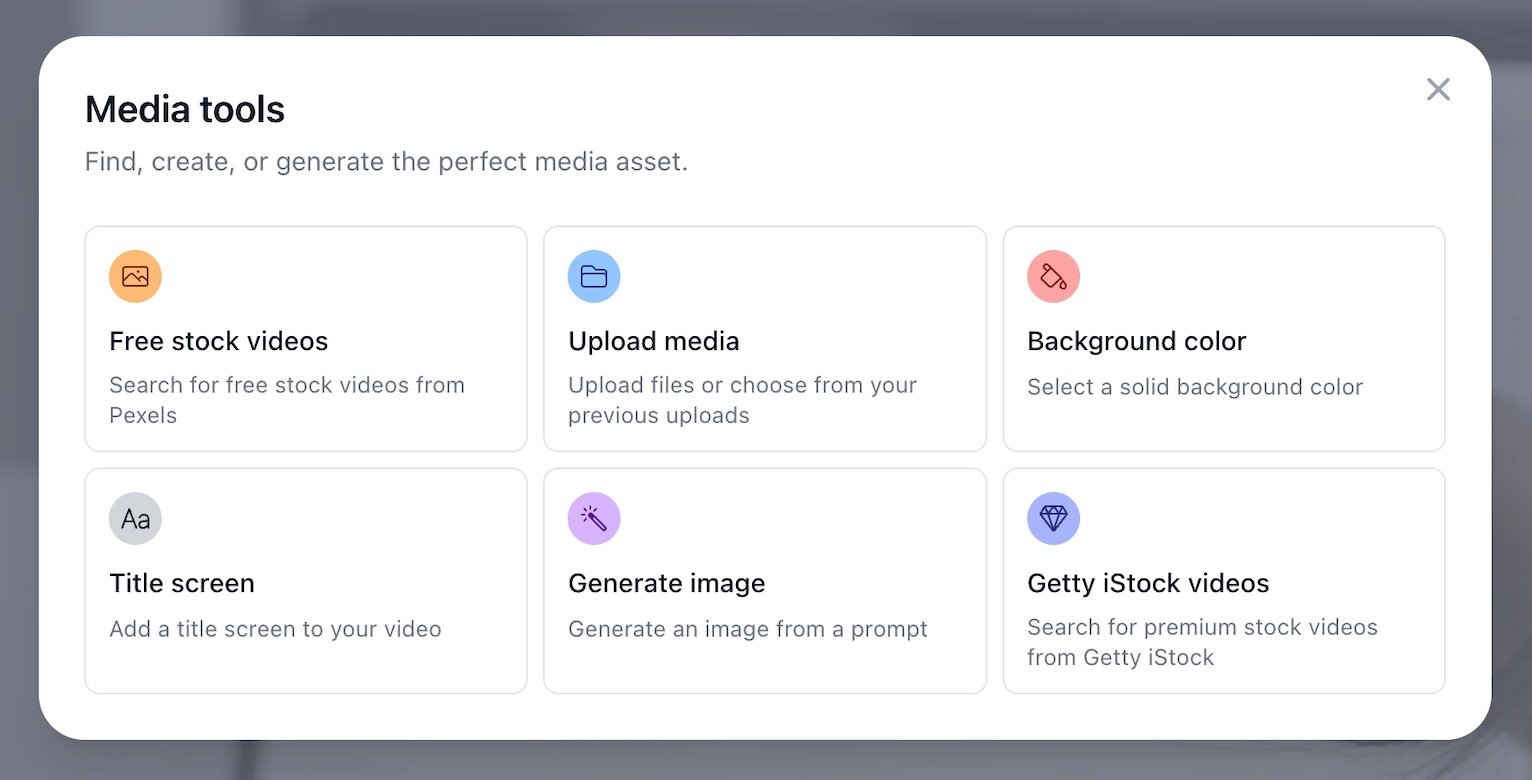
Media tools are a set of flows to create and generate assets in the project editor. You can access these tools in the right side panel by clicking on the asset in the timeline. For a blank asset, the list of available tools will appear directly in the side bar. For a populated non-transcript asset, click "Replace" to replace the asset with the output of a media tool.
The following tools are currently available:
- Free stock videos
- Getty iStock videos
- Upload media
- Background color
- Title screen
- Generate image
Many more generative AI tools are coming soon!
Automatic music selection
All videos are now generated with a background music track to complement the content of your video. To power this system, we built an AI music agent that intelligently analyzes your video outline and automatically selects the perfect track from our music library. We also enhanced our music library with many more tracks to cover a wide range of different genres, moods, and tempos.
Other improvements and fixes
- Implemented more optimizations to video preview in the project editor, further reducing lag for long videos.
- Improved UX on title screen creation in the timeline, preventing accidental additions of overlays to projects.
- Patched issue causing English text to briefly flash before loading translations for non-English users.
- Added usage limit modal to clearly indicate how long you have to wait for your AI usage limit to reset.
- Fixed several small styling and layout shift issues on mobile.
Optimized timeline and preview
We reimplemented our timeline and preview to only load what's necessary for the visible portion of your video, allowing for optimized playback of long videos in the project editor. Previously, videos over 10 minutes long could be somewhat laggy.
Smarter AI agent for media editing
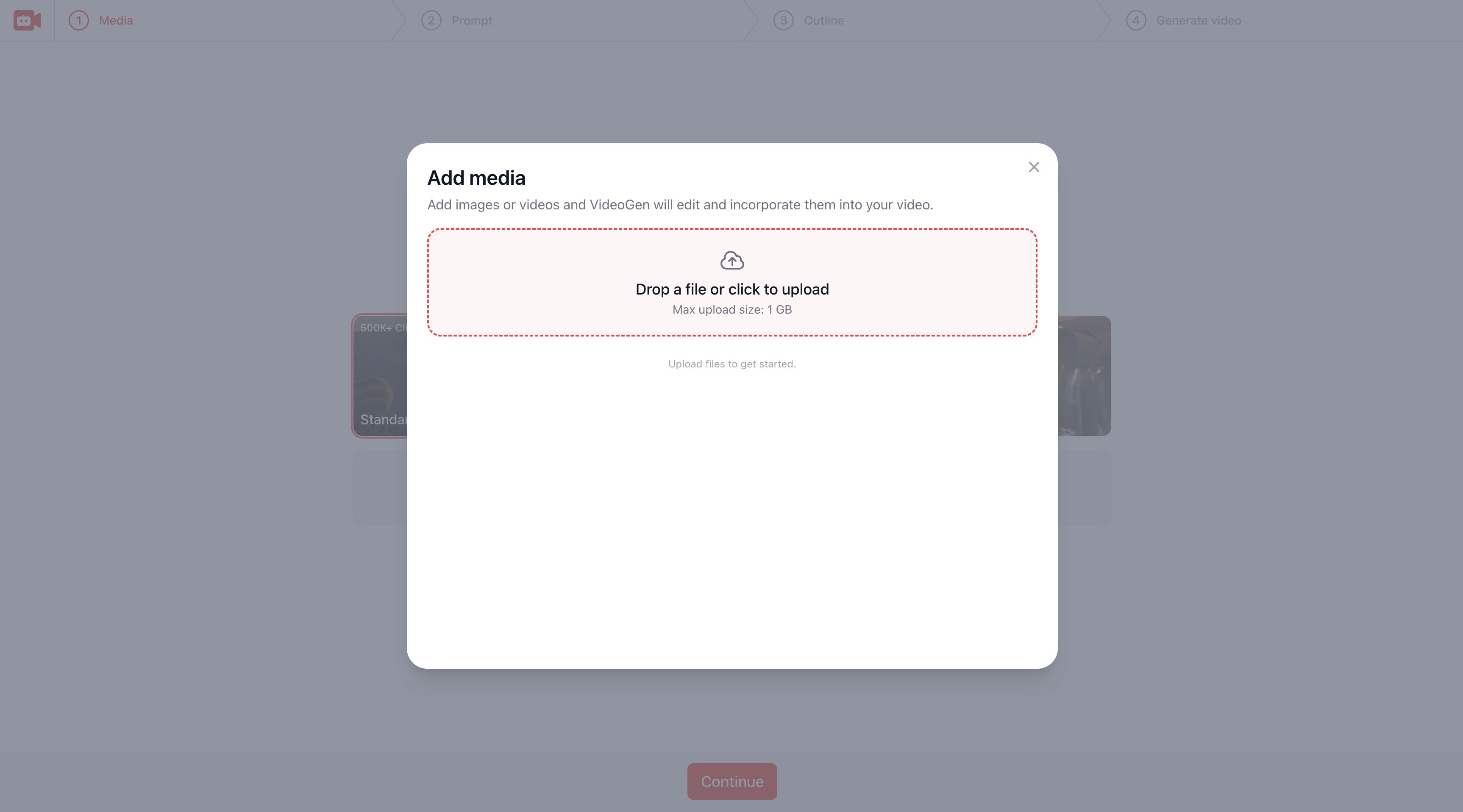
When you include your own media assets in the video generation form, VideoGen places each of these assets where they are most relevant to the voice-over script. We overhauled our system for this with a new AI agent that understands the content of each asset and intelligently edits together the entire b-roll track. The agent will also choose different animation styles depending on its categorization of the asset (e.g., screenshot, icon, infographic).
Other improvements and fixes
- Fixed issue causing a few users with multiple expired subscriptions to not see their most recent subscription.
- Changed default caption style to highlight the current spoken word, making the captions more engaging.
- Updated trimmer logic to properly render all asset trimmers within the bounds of the layer.
- Removed lag when trimming the start and end times of a background asset.
- Resolved bug causing some video exports with Getty iStock assets to fail.
- Increased chromatic variety of sequential generative images in generated video.
Avatars
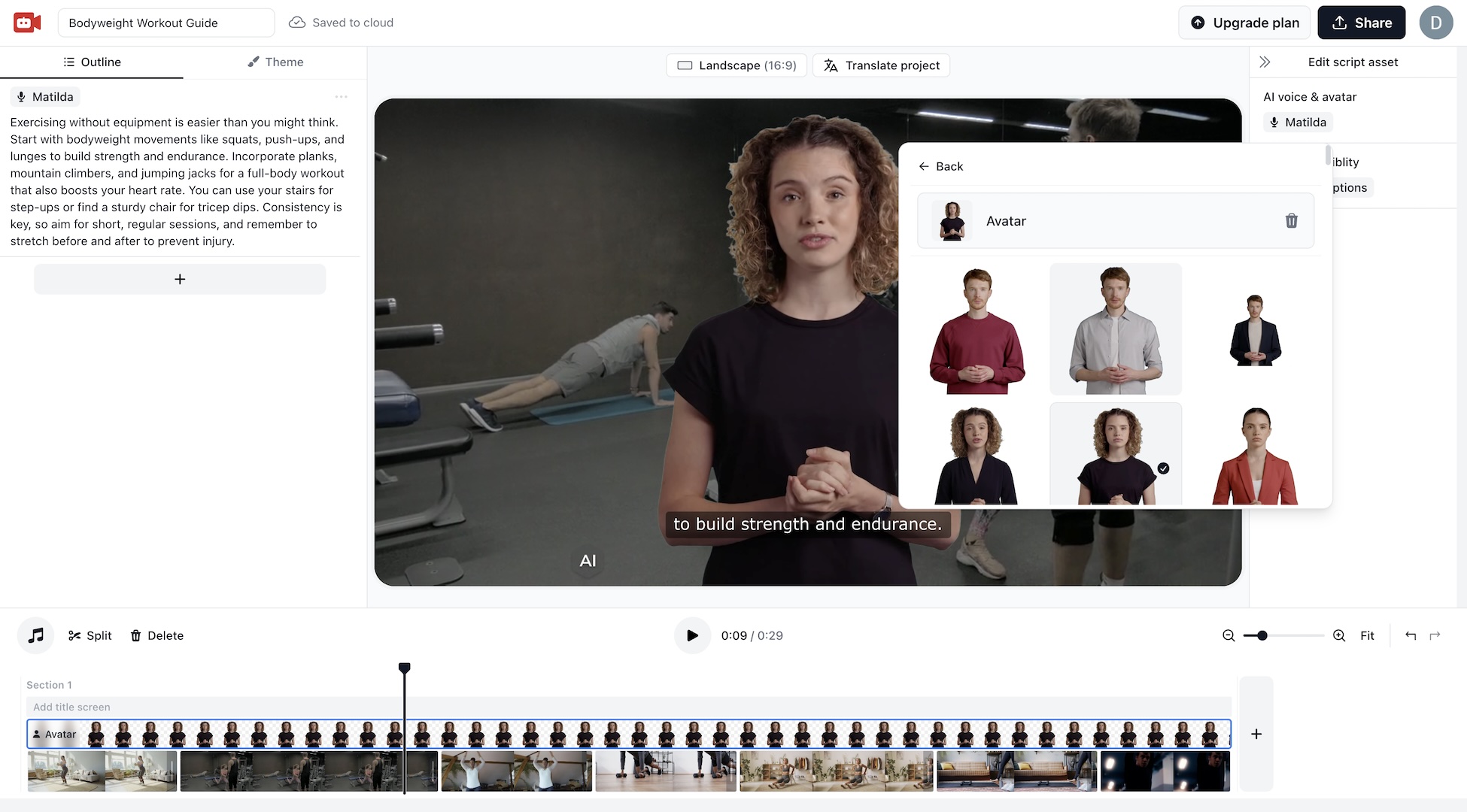
You can now generate an AI avatar on top of your video to present your voice-over script with matching lip movements. Choose from our library of over 100 lifelike presenters to make your videos more engaging and personal. Avatars are currently only available to Business and Enterprise subscribers.
To add an AI avatar to an existing AI voice section, click on the speaker name, click on the avatar button at the top of the popover, select your favorite avatar presenter, and then click generate. Your avatar will be ready to preview and export within a few minutes!
Multi-layer timeline
We extended the timeline to have multiple layers to allow for more flexibility and customization in your videos. The bottom layer shows the background assets, which you can trim, split, replace, and rearrange. The middle layer shows the script asset, which corresponds to your AI voice and/or avatar. Finally, the top layer shows your title screen overlay, which you can customize in the "Theme" tab on the left side panel. In the timeline, you can also click on an asset to select it and view more advanced editing capabilities in the right side panel.
Other improvements and fixes
- Implemented various fixes to teams, allowing for seamless transfer between personal and teams subscriptions.
- Resolved bug causing newly generated sections in the project editor to occasionally repeat background assets already present in the video.
- Revamped text overlays to export significantly faster, especially for long videos.